Saturated Evaporative Media
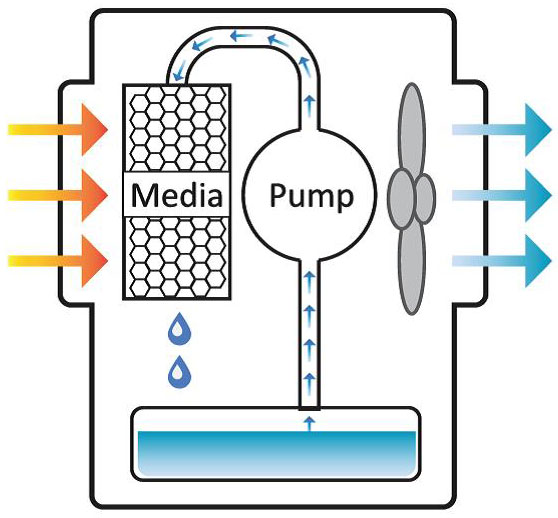
Water is circulated through evaporative media, creating a large wet surface for incoming air to pass through.

Warm air, water and airflow come together in a surprisingly simple cooling process. Here's how Cool Boss uses evaporation to help take the edge off the heat.
Evaporative cooling uses the natural relationship between water, heat and moving air.
A direct evaporative air cooler draws warm outside air through water-saturated media. As water evaporates into that airstream, it absorbs heat. A fan then moves the resulting cooler air into the workspace.
Unlike refrigerated air conditioning, the process does not rely on a compressor-driven refrigeration cycle. It is designed around fresh-air exchange, making ventilation an important part of how the system operates.
Water is circulated through evaporative media, creating a large wet surface for incoming air to pass through.
The fan draws warm air through the saturated media instead of repeatedly recirculating the same enclosed air.
As water changes from liquid to vapor, it absorbs heat from the incoming airstream and lowers its dry-bulb temperature.
Watch how Cool Boss combines water circulation, evaporative media and high-volume airflow into a portable cooling system.
The exact controls and features vary by Cool Boss model, but the fundamental direct evaporative cooling process follows the same basic sequence.
Depending on the model and setup, water is supplied to the cooler so the internal circulation system can keep the evaporative media wet.
The water system distributes water over the evaporative media, creating the wet surface needed for evaporation.
Warm outside air is pulled through the water-saturated media by the cooler's fan.
As the warm air passes through the media, some of the water evaporates and absorbs heat from the airstream.
The evaporation process lowers the dry-bulb temperature of the air while increasing its moisture content.
The fan directs the evaporatively cooled airflow toward the area where cooling is needed.
When liquid water becomes water vapor, the phase change absorbs heat.
In an evaporative cooler, that heat comes from the warm incoming air. As evaporation occurs, the air's dry-bulb temperature falls while its moisture content increases.
How much cooling is possible depends heavily on the temperature and humidity of the incoming air. Hotter, drier conditions generally provide greater evaporative cooling potential than humid conditions.
Evaporative cooling does not produce the same temperature change under every condition. Climate, ventilation and equipment selection all matter.
Lower relative humidity generally allows more water to evaporate into the incoming air, increasing cooling potential.
The temperature of the air entering the cooler influences the conditions available for evaporative cooling.
Direct evaporative cooling is designed around fresh-air exchange. Openings allow incoming cooled air to move through the workspace.
Evaporative coolers work differently from refrigerated A/C, so the space should be operated differently too.
Conventional air conditioning commonly recirculates and conditions air in a more enclosed space. Direct evaporative cooling continually introduces outside air that has passed through wet media.
Providing a path for air to exit helps maintain fresh-air movement and prevents excess humidity from accumulating inside the workspace.
Cool Boss packages direct evaporative cooling into equipment designed for demanding workspaces where mobility and airflow matter.
Provides a large wet surface area for warm incoming air to pass through.
Keeps water moving across the media while the cooling system is operating.
Moves evaporatively cooled air out of the unit and toward the active workspace.
Allows compatible Cool Boss models to be repositioned as cooling needs change.
Actual temperature reduction, coverage and airflow depend on the Cool Boss model, ambient temperature, relative humidity, ventilation, placement and other operating conditions. Review the specifications for the individual model when selecting equipment for your application.
Compare Cool Boss portable evaporative air coolers, specifications and features to find the right equipment for your space.
In order to choose the right air cooler, you’ll want to know how they work. They’re actually quite simple, as this page shows. Plus, there’s no installation required! Your Cool Boss portable evaporative air cooler is ready to plug in and use straight out of the box!
Also called swamp coolers, evaporative air coolers are intended to save you lots of money in the long run without damaging your bottom line in the short run. Not many tools in this world make such ideal solutions to serious problems. In this case, we’re economically handling still air and stifling heat, and we’re doing it in style. Then again, not many tools use something natural and easy like evaporation in order to achieve their end goal. Swamp coolers cool air the same way our bodies cool themselves off when we sweat. Sweat droplets evaporate and reduce the air temperature around our skin. It cools us off.
So, how effective is the process by which Cool Boss reduces temperatures in your workspace? Effective enough that our swamp cooler uses the same survival technique primates have used for hundreds of thousands of years. So enjoy cooling off, you caveman, you.