Direct Evaporative Coolers
Air passes directly through water-saturated evaporative media before being delivered into the workspace.
Cool Boss System
Direct, indirect and mounted evaporative cooling systems approach the same challenge in different ways. Understanding those differences can help you choose the right system for your space.
Evaporative cooling systems vary in how they cool the air, how they're installed and how cooled air is delivered into the space.
Some systems are portable and can be moved directly to the work area. Others become part of the building and may use windows, roofs or ductwork to distribute air.
The right approach depends on factors such as workspace size, climate, ventilation, installation requirements and how much flexibility you need.
Air passes directly through water-saturated evaporative media before being delivered into the workspace.
Cool Boss SystemThese systems use a heat-exchange process that separates the primary supply air from the evaporative cooling stage.
Permanently installed systems can be configured at the ground, window or roof depending on the building and application.
Direct evaporative coolers use water and airflow to reduce the temperature of the air passing through the unit.
Warm air is drawn through water-saturated evaporative media. As water evaporates, heat is absorbed from the airstream. A fan then moves that evaporatively cooled air into the surrounding space.
Cool Boss uses direct evaporative cooling. Its portable design allows the cooler to be positioned near the area where additional cooling and airflow are needed.
Explore Cool Boss Air CoolersDirect evaporative cooling uses the natural evaporation of water to absorb heat from an incoming airstream.
The fan draws warm air toward the evaporative media.
Water moving through the media evaporates, absorbing heat from the passing air.
The fan delivers the resulting evaporatively cooled airflow into the workspace.
Indirect systems separate the evaporative cooling process from the primary supply airstream.
Rather than sending air that has passed directly through wet media into the workspace, indirect systems use a heat exchanger to transfer cooling between airstreams.
These systems are typically more integrated into a facility than portable direct evaporative coolers and can require additional equipment, installation or ductwork.
Some systems also combine indirect and direct stages. The appropriate design depends on the building, climate and desired operating conditions.
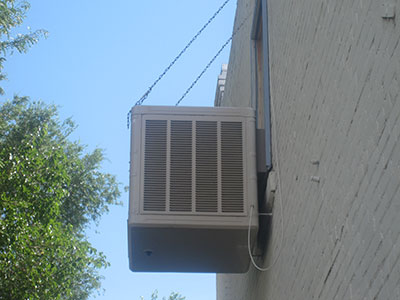
Mounted systems trade portability for a more permanent connection to the building. The installation method depends on the structure, available fresh air and how the cooled air needs to enter the space.
The cooler is installed at or near ground level and connected to the space it serves. Placement and air distribution should be considered carefully when designing the system.
A window installation provides the cooler with direct access to outside air while delivering cooled airflow into the building.
Roof-mounted systems are commonly used in larger applications and may distribute air through ductwork to one or more areas of a building.
Temperature and relative humidity affect evaporative cooling performance.
Direct evaporative cooling benefits from a supply of fresh air and a path for air to leave the space.
Airflow requirements and cooler capacity should match the size and layout of the area being cooled.
Consider whether you need a portable solution or a permanent building installation.
Think about where people work and where the resulting airflow needs to travel.
Portable equipment can be repositioned as work areas and cooling needs change.
Cool Boss combines direct evaporative cooling with a portable format designed for shops, warehouses and other open workspaces.
Instead of becoming a permanent part of the building, a portable evaporative cooler can be positioned around the facility as cooling needs change.
Shop Evaporative Air CoolersActual temperature reduction and effective cooling area depend on factors including ambient temperature, relative humidity, ventilation, airflow, placement, workspace layout and the specific cooler model.
Compare portable evaporative air coolers, airflow, specifications and features to find the model that fits your workspace.
There are several kinds of evaporative air coolers. Some are portable and others must be fixed somewhere to the wall; some fixed units blow air straight into the building, while others use duct systems to transfer air to multiple locations. However, evaporative air cooler ducts are often larger than conventional ducts, and the wrong duct system will decrease the effectiveness of your air cooler. Knowing the conditions of your home or shop will help you determine which cooler you want. There are three types of evaporative air coolers:
The air cooler you choose will depend on the size of your space, your geographic location and other considerations that are covered below.
Often referred to as swamp coolers, these devices are arguably the most cost-effective temperature management solution. They’re inexpensive to operate, rarely require maintenance and are often portable enough to transfer anywhere you want. There’s also no installation required: they’re ready to work out-of-the-box; just plug them in and add water to the reservoir.
Cool Boss falls into the direct swamp cooler classification. These units use the natural cooling properties of water vapor to lower the air temperature in your shop by as much as 26°F on a hot, dry day. Warm air from the outside enters the evaporative media pad, where it gets trapped; air molecules are cooled by evaporation as water drips through the pad. The moistened (but still dry) air is pushed throughout industrial space by a powerful 30” diameter fan. Unlike some evaporative air coolers in this category, Cool Boss is 100% portable and cools over 2,000 sq. ft. That’s enough fan power to cover mid-to-large shipping and receiving facilities!
These coolers are not swamp coolers, as they don’t add humidity to the air. They’re also not portable. On the other hand, the indirect cooling method allows industrial spaces, restaurants or other businesses to cool their spaces to temperatures that are lower than those offered by portable swamp coolers like Cool Boss. All evaporative cooler types have one thing in common: the hotter the outside air, the better the device works. Indirect coolers utilize a secondary air source that can be heated up before it even enters the evaporative media pad. Simply put, two air sources can be combined, heated and then chilled by one or two stages of evaporation.
The downside is that these units are significantly larger and more expensive than Cool Boss, and they usually require a duct system to transfer air; operators will lose some of the money-saving component that makes swamp coolers and direct evaporative air coolers so appealing. Still, indirect evaporative air coolers remain cheaper than A/C.
The downside is that these units are significantly larger and more expensive than Cool Boss, and they usually require a duct system to transfer air; operators will lose some of the money-saving component that makes swamp coolers and direct evaporative air coolers so appealing. Still, indirect evaporative air coolers remain cheaper than A/C.
Mounted coolers - There is some crossover between direct and indirect coolers. Indirect air coolers must be mounted, whereas direct air coolers can be mounted or portable. There are three ways to mount an evaporative air cooler: on the floor, a windowsill or the roof.
Ground-mounting is the least popular method for installing air coolers; cold air falls and hot air rises, so there’s less circulation of cool air if it’s being generated close to the floor.
Window-mounting is a popular option for smaller rooms and work spaces. An air cooler that’s been window-mounted will always have access to a source of fresh air.
Roof-mounting evaporative air coolers is a common commercial/industrial practice but is not recommended for most private residences. These units require air ducts, and they’re more likely to need expensive maintenance over time. However, installation is simple, especially if the appropriate air ducts are already installed in the building.
Whether you’re looking for a portable evaporative air cooler (a.k.a. swamp cooler) or a more permanent solution, air coolers are much cheaper to run than A/C. Cool Boss uses the direct cooling method, so it’s arguably one of the most cost-effective air coolers available. If you have a large warehouse, shop or commercial workspace, the Cool Boss may be the best and least expensive way for you to keep cool when things get hot.